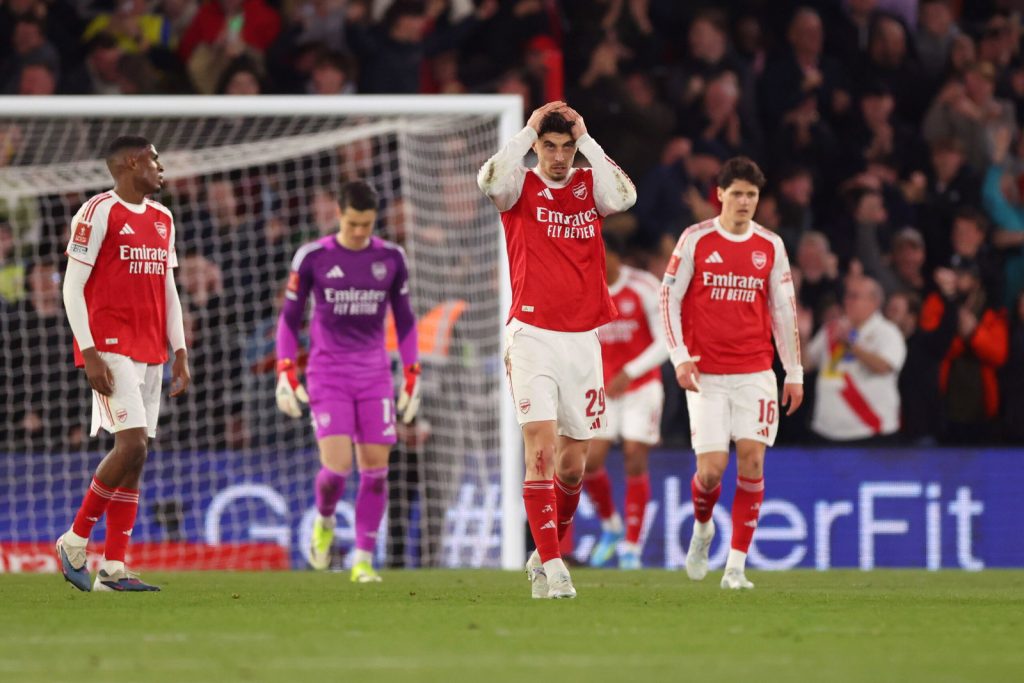
The 2-1 defeat to Southampton at St. Mary’s on April 4th was more than just an FA Cup exit; it was a microscopic look at the remaining fractures in Mikel Arteta’s five-year project. For a club that has spent half a decade preaching “patience,” the manner of this loss—characterised by mental sluggishness and a startling reliance on a 16-year-old—raises a haunting question: Has the political and financial capital afforded to this project created a squad that is comfortable with “the process” but incapable of “the prize”?
As Arsenal prepare for a season-defining Champions League clash with Sporting CP, the fallout from St. Mary’s suggests that the “trust” once given unconditionally by the fanbase is finally meeting its expiration date.
I. The mentality trap: Why the “Bottling” label persists
The most damning indictment of the performance was the collective psychological state of the squad. At this stage of a Premier League and European campaign, matches are won as much in the mind as they are on the pitch. Arsenal appeared physically present but mentally sluggish from the opening whistle.
This lack of “switched-on” focus is particularly alarming because it suggests a fragility that opponents have learned to exploit. While the media often shields Arteta by focusing on “young squads” and “rebuild phases,” the reality is that the 2026 version of Arsenal is an expensive, mature assembly of talent. By failing to match the intensity of a Championship-bound or mid-table Southampton, Arsenal have allowed the “bottling” narrative to regain its momentum. As we all know as football fans, you have to be fully up for these games at this stage of the season; if you aren’t, you aren’t just losing a game—you’re losing your identity as a title contender.
II. The Gabriel Jesus conundrum: A symbol of stagnation
The disparity between the club’s highest earners and their on-field contribution has reached a breaking point. Gabriel Jesus, once the transformative signing that signaled the “end of the beginning” for Arteta, now serves as a symbol of the squad’s fringe-player problem. Injuries appear to have robbed him of the explosive movement and tenacity that defined his early Arsenal career.
In a game where Arsenal needed a focal point to break down a resilient Southampton block, Jesus offered nothing in the press, failed to hold the ball up, and was a non-entity in the box. Arteta has been given hundreds of millions to “flush out the deadwood,” yet he now finds himself with a new layer of highly-paid players who are “everywhere but equally nowhere”. This is a critical point for the Arsenal Mania audience: if the “Process” was about ruthless efficiency, why is the wage bill still burdened by players who cannot impact a domestic cup quarter-final? The “rectification” mentioned for the summer cannot come soon enough.
III. “We paid the price”: Arteta’s admission of failure
In the immediate aftermath, Mikel Arteta was uncharacteristically blunt. Usually one to defend the “intent” of his players, Arteta instead took the hit for a performance that lacked the clinical edge he demands. He admitted that while Arsenal had periods of “many, many moments of dominance,” they simply failed to capitalise .
“When you defend in and around the box in the manner that we did today, you’re going to put yourself in a really difficult position,” Arteta told the media. His admission that the team was “poor in and around our box” was a rare public concession that the defensive structure—once the bedrock of his rebuild—had failed under basic pressure. His message to the players was clear: “Stand up, make yourself accountable.” The manager knows that at this level, you cannot expect to win based on possession stats alone; you have to “wake up” to the reality of knockout football.
IV. Nørgaard’s “Very Stupid” verdict: The veteran’s frustration
While Arteta’s comments were measured, Christian Nørgaard’s post-match interview provided the raw, unfiltered truth of the dressing room. Returning from the international break, the Danish midfielder did not hold back, labeling the defensive lapse that led to Shea Charles’ winning goal as “very stupid”.
Nørgaard’s frustration centered on a lack of game management. He described the atmosphere as “too chaotic” and pointed out that after Viktor Gyokeres had equalised in the 68th minute, the team should have had the maturity to see the game out or push for the win without overextending . Instead, a lack of concentration allowed a Championship side to execute a “perfect giant-killing.” Nørgaard’s call for “positive body language” and to stop going with “heads down” suggests a deeper morale issue that Arteta must address before the squad flies to Portugal.
V. Tactical discomfort: The Myles Lewis-Skelly experiment
The defensive struggles went beyond simple errors. The deployment of Myles Lewis-Skelly at left-back highlighted a growing discomfort within Arteta’s tactical rigidity. While the youngster has shown immense promise as a technical midfielder, his positioning as a senior defender looked forced and awkward.
Southampton’s coaching staff clearly identified this as a weak point, repeatedly sending balls over the top to bypass the midfield press and exploit the confusion in the backline. When established players like Ben White are also “on the ropes” and making uncharacteristic mistakes, it suggests that the “Process” might be over-complicating the simple task of defending. You cannot afford to be “learning on the job” in an FA Cup quarter-final, yet that is exactly what the defensive setup felt like.
VI. The 16-Year-Old savior: A statistical indictment
The only genuine positive from the evening was the performance of Max Dowman. The 16-year-old was the only player who consistently threatened, showing a relentless determination to take on his man and drive into the opposition box.
However, Dowman’s brilliance is a double-edged sword for the narrative. While it is exciting to see a Hale End product shine, it is an indictment of the senior attacking unit that a teenager led the team in “shots, duels, and touches in the opposition box”. Why are the senior attackers—some of whom are among the highest earners in the league—not even close to the 16-year-old’s output?. This reveals a vacuum of leadership and a squad that has become too reliant on “following the instructions” rather than using individual bravery to win a game.
VII. The turning point: Portugal and beyond
The defeat at St. Mary’s has turned up the volume on the criticism surrounding the “Patience Disparity” in the Premier League. Arteta has been given the time and the resources that few other managers in the world receive. With the FA Cup and Carabao Cup now gone, the margin for error in the Premier League and Champions League has vanished.
The trip to face Sporting CP is no longer just another European fixture; it is a test of whether the “wake-up call” Arteta demanded has been heard. If the senior players continue to show “poor body language” and the defense continues to make “stupid” errors, the political capital that has protected Arteta for years will finally run out.
Arsenal are running out of opportunities to win things this season. The pressure is on the manager, and the pressure is on this squad. At St. Mary’s, they showed they couldn’t handle the heat. In Lisbon, they must show they are made of something stronger.


